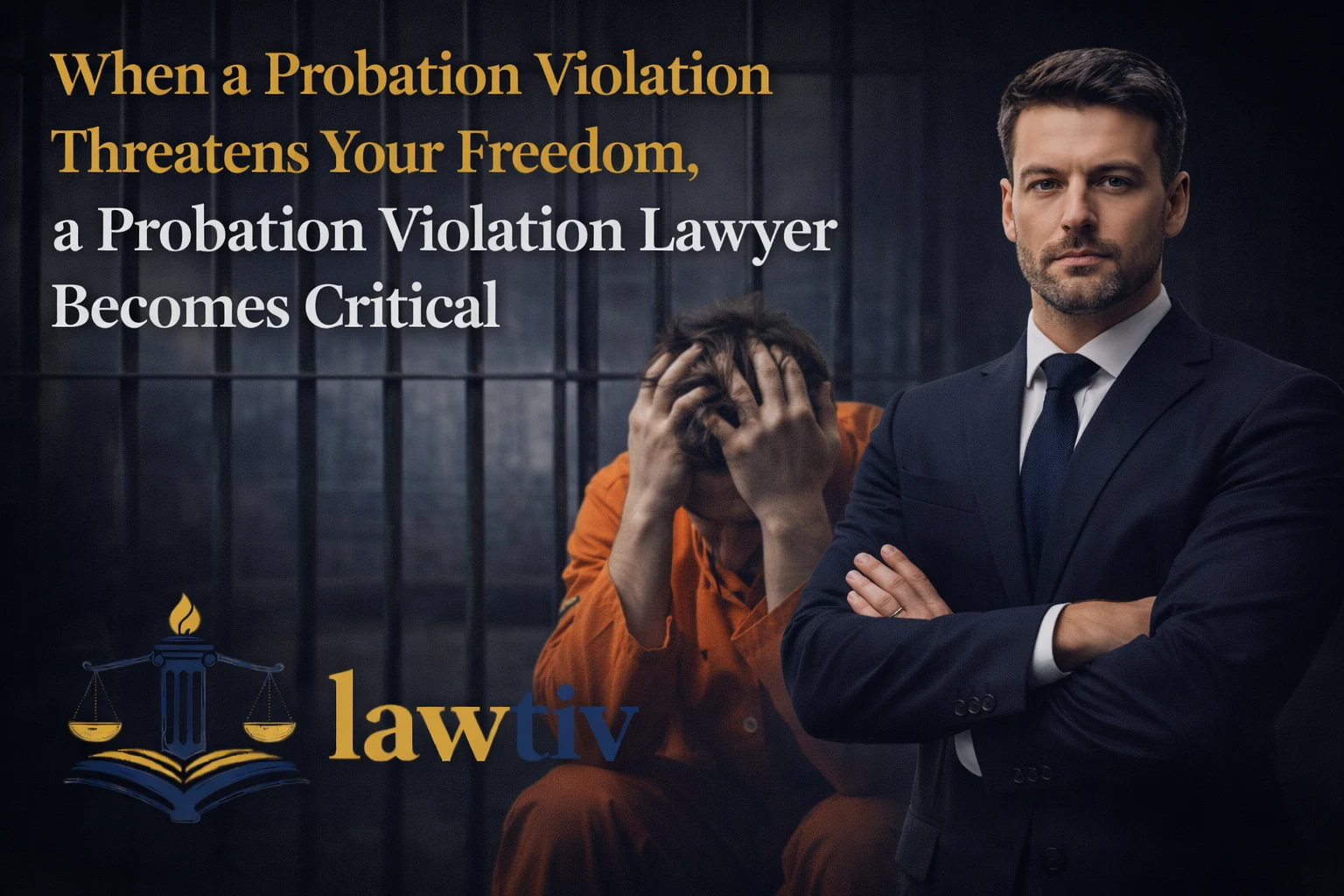
A probation sentence often appears to offer relief from jail. Judges present probation as an opportunity to rebuild life outside a cell while remaining under court supervision. Yet the moment a violation allegation surfaces, that opportunity can collapse quickly.
A probation violation hearing carries real consequences. Judges possess authority to revoke probation and impose the original jail sentence. Even minor technical violations can trigger arrest warrants, court hearings, and serious penalties.
Legal defense becomes crucial at this stage. A probation violation lawyer steps in to examine the accusation, challenge the evidence, and present a defense that protects freedom. Skilled representation can mean the difference between returning home or entering a jail facility.
The legal terrain surrounding probation violations is complex. Court procedures move quickly, probation officers hold significant influence, and many defendants enter hearings without fully understanding their rights. Professional legal guidance brings structure, strategy, and advocacy to a situation where every detail matters.
How Probation Works in the United States Criminal Justice System
Probation functions as a sentencing alternative that allows a defendant to remain in the community instead of serving time in jail or prison. Courts impose probation after a conviction or plea agreement. The judge sets conditions that must be followed for the duration of the probation term.
These conditions vary by jurisdiction and case type. Courts often require regular meetings with a probation officer, compliance with curfews, drug testing, payment of fines, and completion of counseling or rehabilitation programs.
Probation serves several goals within the justice system. Courts use it to monitor behavior, reduce incarceration rates, and encourage rehabilitation. For many individuals, probation becomes a second chance to correct mistakes and demonstrate responsibility.
The system also operates under strict accountability. Violations can occur when probation conditions are not followed precisely. Even small missteps can attract legal scrutiny, making legal representation vital once an allegation arises.
Judicial Authority Over Probation Conditions
Judges maintain full authority over probation terms and enforcement. At the time of sentencing, the court determines how long probation will last and what requirements the defendant must follow.
Courts may tailor conditions to the circumstances of a particular case. A drug related offense may involve treatment programs and testing. Domestic violence cases may include protective orders and anger management counseling.
The court also determines how violations will be handled. Some violations trigger warnings or adjustments to probation terms. Other violations may lead directly to revocation hearings.
Judicial discretion plays a major role. A probation violation lawyer presents arguments designed to influence the judge’s perception of the violation and the defendant’s overall conduct.
The Role of Probation Officers
Probation officers act as supervisors responsible for monitoring compliance with court orders. They review progress, document violations, and report findings to the court.
These officers possess significant influence in violation cases. Their reports often serve as the starting point for legal proceedings. If a probation officer believes a violation occurred, the officer may request a warrant or schedule a violation hearing.
Communication between the probation officer and defendant becomes extremely important. Misunderstandings, missed appointments, or administrative mistakes sometimes trigger violation allegations.
A defense lawyer frequently investigates these interactions to determine whether the alleged violation reflects actual misconduct or a misunderstanding.
Situations That Commonly Lead to Probation Violation Allegations
Probation violations fall into two general categories. Courts classify them as technical violations or new criminal offenses.
Technical violations involve failure to follow administrative conditions imposed by the court. New offenses occur when an individual on probation is arrested or charged with another crime.
Many probationers underestimate how strict the system can be. Small actions can escalate quickly within the legal system.
Missing Required Meetings or Check Ins
Regular meetings with a probation officer form the backbone of probation supervision. Courts expect probationers to appear for scheduled appointments and maintain consistent communication.
Missed meetings can trigger immediate concern. Probation officers may interpret repeated absences as intentional avoidance or noncompliance.
Life circumstances often contribute to missed appointments. Transportation problems, work schedules, or family emergencies can create complications. Courts do not always view these explanations as sufficient.
A probation violation lawyer can present evidence explaining why the absence occurred and argue that the violation does not justify severe punishment.
Failing Drug or Alcohol Testing
Drug testing requirements frequently appear in probation terms, especially in cases involving substance related offenses.
Testing programs operate under strict rules. A failed test, refusal to test, or missed test appointment may count as a violation.
False positives and laboratory errors sometimes occur. Certain medications can produce misleading results in drug screenings.
Defense attorneys examine laboratory procedures, testing protocols, and medication records to challenge inaccurate test results.
Failure to Pay Fines or Complete Court Programs
Courts often require probationers to pay fines, restitution, or court fees. Many individuals struggle financially while attempting to comply with these obligations.
Financial hardship can create a legal dilemma. Courts may interpret unpaid fines as defiance of court orders.
Probation conditions sometimes include educational courses, therapy sessions, or rehabilitation programs. Missing required classes can also lead to violation reports.
A probation violation lawyer may demonstrate financial limitations or scheduling conflicts that prevented compliance.
Legal Consequences That Follow a Probation Violation
Violation allegations trigger legal proceedings that can drastically alter a defendant’s future. Judges review evidence and determine whether probation should continue.
Possible consequences vary depending on the severity of the violation and the defendant’s prior record.
The legal system treats violations seriously because probation represents a court ordered privilege rather than an automatic right.
Probation Revocation and Jail Sentences
The most severe consequence involves revocation of probation. When probation is revoked, the court cancels the probation arrangement and imposes the original sentence.
This sentence often includes jail or prison time. Individuals who believed they avoided incarceration may suddenly face confinement.
Courts weigh several factors when deciding whether revocation is appropriate. These factors include the seriousness of the violation, previous warnings, and overall compliance history.
Defense lawyers attempt to demonstrate that the violation does not justify incarceration.
Extended Probation Terms
Judges sometimes choose to extend the probation period rather than revoke it completely.
An extension adds months or even years to the supervision timeline. The court may also add new requirements such as additional counseling or increased reporting obligations.
Extended probation creates ongoing legal pressure. Individuals must maintain compliance for longer periods while living under supervision.
Defense lawyers frequently negotiate outcomes that reduce the length of these extensions.
Additional Penalties and Restrictions
Courts may impose new conditions after a violation. These can include electronic monitoring, house arrest, community service obligations, or additional fines.
These penalties can disrupt employment, housing stability, and family responsibilities.
Legal defense focuses on minimizing restrictions and protecting a defendant’s ability to maintain normal life activities.
The Strategic Role of a Probation Violation Lawyer
A probation violation lawyer operates as both investigator and courtroom advocate. The lawyer reviews the allegation, analyzes evidence, and builds a legal defense tailored to the situation.
Many defendants mistakenly believe violation hearings are informal administrative meetings. These hearings carry legal weight and can determine whether incarceration occurs.
Professional representation ensures the defendant receives procedural fairness and a strong defense.
Case Investigation and Evidence Analysis
Defense attorneys begin by examining the evidence behind the violation allegation. This process may involve reviewing probation reports, test results, communication records, and police documents.
Investigation sometimes reveals inconsistencies in the probation officer’s report or weaknesses in the evidence presented to the court.
Witness statements, employment records, and medical documentation may also support the defense.
A thorough investigation transforms a simple accusation into a contested legal matter where facts must be proven.
Building a Defense Strategy
Legal defense strategies vary widely depending on the nature of the violation.
Some cases involve demonstrating that the violation never occurred. Other cases focus on presenting mitigating circumstances that justify a second chance.
Attorneys may highlight rehabilitation efforts, employment stability, family responsibilities, or successful treatment programs.
Judges often respond favorably to defendants who show accountability and a willingness to comply with court expectations.
Advocacy During Violation Hearings
Violation hearings differ from traditional criminal trials. The standard of proof is lower, which means judges may rely heavily on probation reports.
This environment places defense attorneys in a crucial position. Skilled advocacy ensures that the judge hears the full story rather than a single perspective.
Defense lawyers challenge evidence, question witnesses, and present arguments that highlight fairness and proportionality.
Courtroom advocacy often shapes the judge’s perception of the case.
How Probation Violation Hearings Work in Court
Violation hearings operate under different procedural rules compared with standard criminal trials. Judges review evidence and determine whether the violation occurred.
The process usually begins with an arrest warrant or court summons issued after a probation officer files a violation report.
Defendants then appear before the court where the judge reviews the allegation and schedules a hearing.
Arrest Warrants and Initial Court Appearances
In some cases the court issues an arrest warrant immediately after a violation report is filed. Law enforcement officers may take the individual into custody until a hearing occurs.
Other cases involve summons notices requiring the defendant to appear voluntarily.
Initial court appearances allow the judge to confirm the allegation and determine whether the defendant remains in custody while awaiting the hearing.
Defense lawyers advocate for release and prepare for the upcoming legal arguments.
Evidence Presented During Violation Hearings
Evidence presented during these hearings may include probation officer testimony, laboratory test results, police reports, and program attendance records.
Judges consider whether the evidence shows a violation by a preponderance of evidence standard. This standard requires less proof than a criminal conviction.
Defense lawyers analyze every piece of evidence carefully. Inaccurate reports or incomplete documentation can weaken the prosecution’s case.
The hearing often becomes a detailed examination of facts and circumstances surrounding the alleged violation.
Judicial Decisions and Sentencing Options
After reviewing evidence, the judge determines whether a violation occurred. If the court finds no violation, probation continues under the existing terms.
If the court determines that a violation occurred, several sentencing options become available.
The judge may issue a warning, modify probation conditions, extend supervision, or revoke probation entirely.
Defense lawyers aim to guide the court toward solutions that allow the defendant to continue rehabilitation within the community.
Factors Judges Consider When Deciding a Violation Case
Judges evaluate numerous factors when determining how to respond to a probation violation. The legal system encourages judges to consider the broader context of a defendant’s behavior.
One key factor involves the nature of the violation. A technical violation may receive a more lenient response than a new criminal offense.
The defendant’s overall probation record also matters. Consistent compliance over time may persuade the court to allow continued supervision rather than revocation.
Judges also examine evidence of rehabilitation. Participation in treatment programs, employment stability, and family responsibilities can influence the outcome of the hearing.
Defense lawyers present these factors carefully to demonstrate that probation still serves its intended purpose.
Practical Comparison of Probation Violation Outcomes
| Situation | Court Response | Possible Legal Outcome |
|---|---|---|
| Minor technical violation | Judicial warning | Probation continues |
| Repeated missed appointments | Increased supervision | Extended probation |
| Failed drug test | Court ordered treatment | Rehabilitation program |
| New criminal charge | Revocation hearing | Possible incarceration |
| Failure to pay fines | Financial review | Payment adjustment |
Long Term Consequences of Probation Revocation
Revocation of probation can carry consequences that extend far beyond jail time. Criminal records become more difficult to manage once incarceration occurs.
Employment opportunities may decline because background checks reveal both the original conviction and the violation.
Housing opportunities can also become limited. Landlords often review criminal history when evaluating rental applications.
Family relationships may suffer as well. Extended incarceration disrupts family stability and financial support systems.
A probation violation lawyer works to prevent these long term consequences by pursuing alternatives to revocation.
How Early Legal Representation Changes Violation Outcomes
Early involvement from a defense lawyer can reshape the entire trajectory of a violation case.
Attorneys sometimes intervene before a formal violation report reaches the court. Communication with probation officers may resolve misunderstandings or correct administrative errors.
Legal counsel also prepares defendants for court expectations. Proper documentation, treatment program enrollment, and employment records can strengthen a defense.
Courtroom preparation matters significantly. Lawyers organize evidence, anticipate questions from the judge, and craft arguments tailored to the circumstances of the case.
This preparation often creates a persuasive narrative that encourages judicial leniency.
FAQs
Can a probation violation lead directly to jail time?
Yes, a probation violation can lead to incarceration if the judge decides to revoke probation. Courts consider the seriousness of the violation and the defendant’s compliance history before imposing jail sentences.
Do probation violation hearings operate like criminal trials?
Violation hearings differ from traditional criminal trials. The prosecution does not need to prove guilt beyond a reasonable doubt. Judges evaluate evidence under a lower legal standard.
What happens if someone misses a probation appointment?
Missing an appointment may trigger a violation report from the probation officer. Courts may respond with warnings, additional supervision, or a formal violation hearing depending on the circumstances.
Can probation be reinstated after a violation?
Courts sometimes allow probation to continue with modified conditions. Judges may extend the probation term or require additional counseling instead of revoking supervision entirely.
Does hiring a probation violation lawyer improve the chances of avoiding jail?
Legal representation often improves the defense strategy presented to the court. Lawyers investigate allegations, challenge evidence, and advocate for alternatives to incarceration.
Is a new criminal charge automatically considered a probation violation?
A new arrest or charge often triggers a violation hearing because probation requires law abiding behavior. Courts review the circumstances carefully before deciding whether revocation is appropriate.
Wrap Up
Probation violations create legal emergencies that move quickly through the court system. Judges possess broad authority to impose penalties, extend supervision, or revoke probation entirely. Individuals facing these allegations often encounter a system that operates faster and more aggressively than expected.
A probation violation lawyer provides the legal structure necessary to navigate this situation. Investigation of evidence, strategic courtroom advocacy, and persuasive presentation of mitigating circumstances often shape the final outcome.
Strong legal defense protects more than freedom. It safeguards employment stability, family relationships, and long term opportunities that could vanish if probation is revoked.