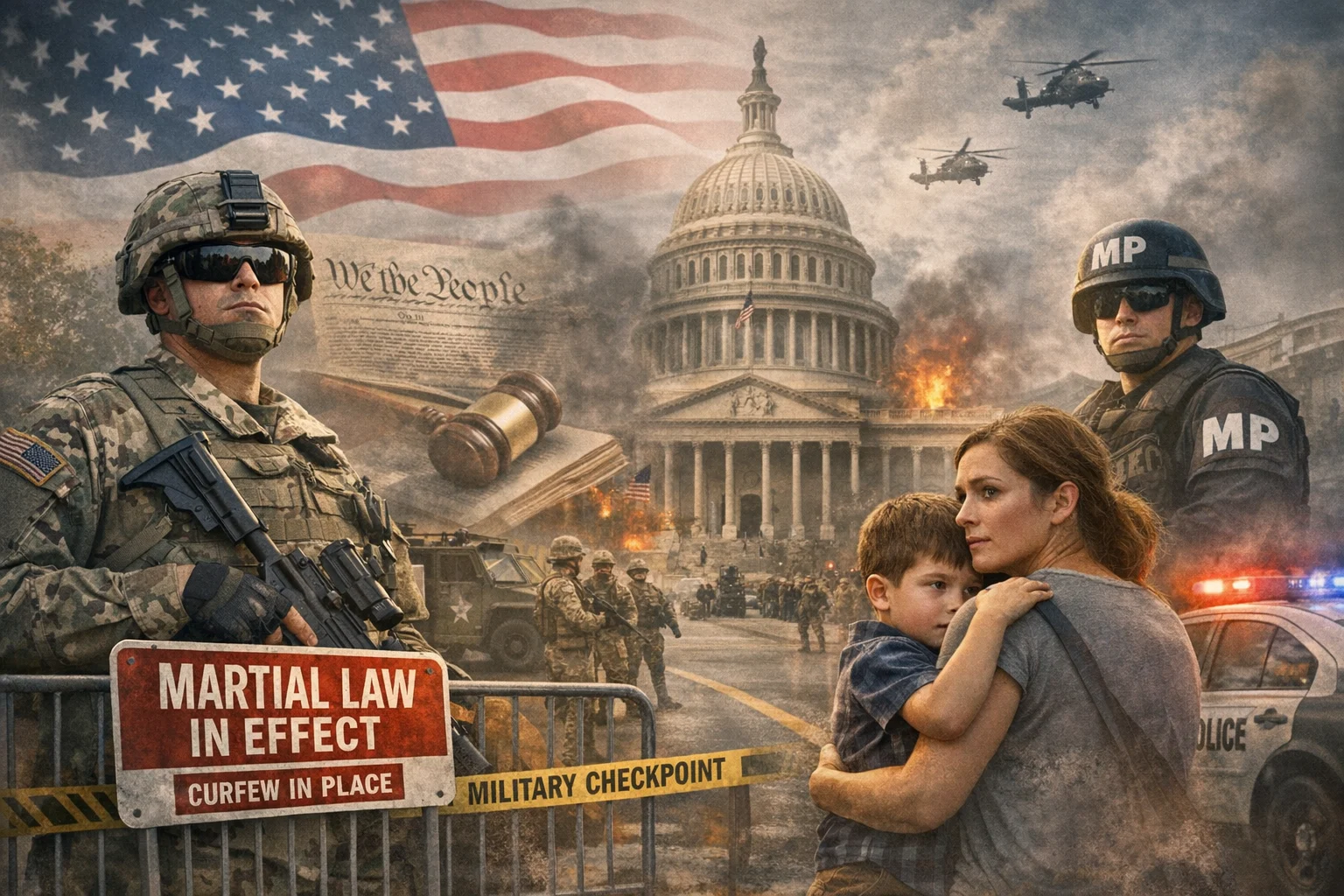
Fear spikes whenever the phrase martial law enters public conversation. It sounds like a total shutdown of freedom, a scenario where soldiers replace judges and everyday life stops. That picture carries fragments of truth, yet it also hides nuance that matters.
Many Americans search for clarity during crises, especially when news cycles amplify uncertainty. Questions about authority, constitutional limits, and personal rights tend to surface at the same time. A clear explanation removes confusion and replaces it with grounded knowledge.
This article breaks down martial law in plain, direct language while preserving legal accuracy. The goal is not only to explain definitions but to show how it actually plays out in real situations across the United States.
What Martial Law Means in Plain Terms
Martial law refers to a temporary transfer of authority from civilian government to military control. This shift happens when normal systems fail to maintain order or respond to extreme emergencies. The military steps in to restore stability, enforce rules, and support public safety.
The idea is rooted in necessity rather than preference. Civil institutions such as courts, police departments, and local governments are expected to function in most circumstances. Martial law becomes relevant only when those systems are overwhelmed or unable to operate effectively.
Public perception often imagines martial law as a permanent or authoritarian condition. In practice, it is meant to be temporary and tied to a specific crisis. The intention is to stabilize conditions until civilian authority can resume full control.
Why Martial Law Exists in the United States
The United States places heavy emphasis on civilian rule, yet history shows that emergencies can disrupt normal governance. Natural disasters, civil unrest, or wartime conditions may stretch local systems beyond their limits.
Martial law exists as a contingency measure. It allows for rapid mobilization of military resources when public safety is at risk. This includes controlling movement, securing infrastructure, and supporting law enforcement operations.
Legal frameworks such as the Constitution and federal statutes shape how martial law can be applied. The system attempts to balance emergency response with protection of civil liberties, even though tensions between those goals often arise.
Martial Law vs Military Assistance
Confusion often arises between martial law and routine military assistance. The military frequently supports civilian authorities without taking control. This includes disaster relief, logistics, and humanitarian aid.
Martial law is different because it involves authority, not just support. Military leaders may enforce rules, impose curfews, or restrict activities that are normally protected under civilian law.
Understanding this distinction prevents unnecessary panic. Military presence alone does not equal martial law. Authority and control define the difference.
Historical Examples of Martial Law in the U.S.
History provides insight into how martial law operates in real situations. These examples show that its use has been limited and often controversial.
One of the earliest instances occurred during the Civil War. President Abraham Lincoln authorized measures that suspended certain rights in areas affected by rebellion. The goal was to maintain national unity during a period of internal conflict.
Another example took place in Hawaii after the attack on Pearl Harbor in 1941. Martial law was declared across the territory. Military authorities controlled courts, transportation, and public activity for an extended period.
Lessons from Past Declarations
Each historical case reveals tension between security and liberty. Courts have reviewed several instances and clarified limits on military authority.
The Supreme Court case Ex parte Milligan in 1866 established that military tribunals cannot replace civilian courts when those courts are functioning. This decision reinforced the idea that martial law has boundaries.
Past experiences highlight the importance of context. Martial law has been used during extreme situations, yet its application has always been subject to scrutiny.
Public Reaction and Legal Debate
Public opinion often shifts depending on the circumstances. During times of crisis, people may support stronger measures. Once stability returns, concerns about rights and overreach tend to surface.
Legal scholars continue to debate how far martial law should extend. Questions about constitutional protections, due process, and executive authority remain active topics in legal circles.
This ongoing debate reflects a broader tension within democratic systems. Emergency powers must exist, yet they must also be restrained.
Who Can Declare Martial Law in the United States
Authority to declare martial law is not clearly defined in a single constitutional clause. Instead, it emerges from a combination of federal and state powers.
Governors may declare martial law within their states under specific conditions. This typically involves situations where local law enforcement cannot maintain order.
The President may also exercise authority during national emergencies. Federal laws such as the Insurrection Act allow deployment of military forces to address unrest or enforce federal law.
Role of State Governors
Governors act as primary decision-makers during state-level crises. They can activate the National Guard and impose restrictions such as curfews or movement controls.
Their authority is grounded in state constitutions and emergency statutes. Each state has its own legal framework, which shapes how martial law may be implemented.
Local conditions often influence decisions. Natural disasters, riots, or infrastructure failures may prompt state-level action.
Role of the President
The President holds broader authority during national emergencies. This includes the ability to deploy federal troops and coordinate responses across multiple states.
Federal involvement usually occurs when state resources are insufficient or when federal law is at risk. The Insurrection Act provides a legal pathway for such action.
Presidential decisions are subject to political and legal oversight. Congress and the courts play roles in reviewing how emergency powers are used.
What Happens During Martial Law
Martial law changes how rules are enforced and how daily life operates. The extent of change depends on the severity of the situation.
Military authorities may impose curfews, restrict travel, and limit gatherings. These measures aim to restore order and prevent further disruption.
Civilian courts may remain open in some cases, while in others military tribunals may temporarily handle certain matters. The structure depends on local conditions and legal interpretations.
Daily Life Under Martial Law
Everyday routines can shift quickly. Movement may be restricted during certain hours. Businesses may operate under special conditions or close temporarily.
Communication channels often remain active, though authorities may regulate certain types of activity to prevent unrest or misinformation.
Public services such as healthcare and utilities typically continue, often with military support to ensure continuity.
Enforcement and Authority Structure
Military personnel take on enforcement roles that are normally handled by police. This includes maintaining order, securing public spaces, and responding to emergencies.
Command structures become more centralized. Decisions may be made quickly to address evolving situations.
This shift in authority can feel unfamiliar, yet it is designed to stabilize conditions rather than replace civilian governance permanently.
Rights and Freedoms During Martial Law
Concerns about rights dominate discussions of martial law. The U.S. legal system attempts to preserve core protections even during emergencies.
Certain rights may be limited temporarily. These can include freedom of movement, assembly, and in some cases aspects of due process.
Courts have emphasized that rights are not erased. Restrictions must be tied to necessity and proportionality.
Constitutional Protections and Limits
The Constitution remains in effect during martial law. This principle has been reinforced through court decisions over time.
Limits on government power still apply. Authorities must justify actions based on the situation and legal standards.
Judicial review provides a mechanism for challenging excessive measures. This acts as a safeguard against abuse.
Practical Impact on Citizens
Citizens may experience restrictions that feel intrusive. Curfews, checkpoints, and identification requirements can become part of daily life.
These measures are typically temporary. Once stability returns, restrictions are lifted and normal rights resume.
Awareness of legal boundaries helps individuals navigate these situations with greater confidence.
Martial Law vs State of Emergency
These terms are often used interchangeably, yet they represent different levels of response.
A state of emergency allows governments to access resources and implement temporary measures without transferring authority to the military.
Martial law represents a more extreme shift where military control becomes central.
Key Differences in Authority and Impact
The following table highlights the distinction in practical terms.
| Aspect | State of Emergency | Martial Law |
|---|---|---|
| Authority | Civilian government remains in control | Military authority takes primary control |
| Enforcement | Police and local agencies lead | Military enforces rules |
| Restrictions | Moderate, targeted measures | Broader and stricter controls |
| Duration | Often shorter and flexible | Tied to severity of crisis |
| Legal Oversight | Civil courts fully active | Courts may operate differently |
Why the Difference Matters
Understanding the difference helps interpret government actions accurately. Not every emergency signals a shift to military control.
Public discourse often blurs these lines, which can lead to unnecessary alarm. Clear distinctions support informed decision-making.
Real World Scenarios Where Martial Law Might Be Considered
Certain situations create conditions where martial law becomes a possibility. These scenarios involve widespread disruption or threats to public safety.
Large-scale civil unrest that overwhelms law enforcement can trigger consideration. Riots that spread across multiple regions may require additional authority.
Severe natural disasters can also lead to temporary shifts in control. If infrastructure collapses and local governance cannot function, military involvement may expand.
National Security Threats
Threats involving terrorism or external conflict may prompt emergency measures. Protection of critical infrastructure becomes a priority.
Military resources provide rapid response capabilities. This includes logistics, security, and coordination across agencies.
Decisions in these scenarios are often influenced by intelligence assessments and risk evaluations.
Breakdown of Civil Order
When law enforcement cannot maintain order, governments may consider stronger interventions. This includes situations where violence or looting becomes widespread.
Martial law is not the first response. It is typically considered after other measures fail.
The goal remains restoration of order, not long-term military governance.
Common Misconceptions About Martial Law
Public narratives often exaggerate the scope and permanence of martial law. These misconceptions can create unnecessary fear.
One common belief is that all rights disappear. In reality, restrictions are limited and subject to legal review.
Another misconception is that martial law is easily declared. Legal and political barriers make it a serious and rare decision.
Media Influence and Public Perception
Media coverage can amplify dramatic interpretations. Headlines may focus on extreme possibilities rather than realistic outcomes.
Accurate information helps counterbalance this effect. Historical context provides perspective on how martial law has actually been used.
Public understanding improves when discussions focus on facts rather than speculation.
Separating Fact from Fiction
Martial law is not a default response to crises. It remains a measure of last resort.
Legal systems continue to operate, even if modified. Oversight mechanisms remain active.
Clarity reduces fear and supports informed civic engagement.
FAQs About Martial Law
What triggers martial law in the United States?
Martial law is considered when civil authorities cannot maintain order or respond effectively to a crisis. This may involve widespread unrest, severe disasters, or national security threats that overwhelm existing systems.
Does martial law mean the Constitution is suspended?
The Constitution remains in effect. Courts have consistently held that constitutional protections continue, though some rights may be temporarily restricted based on necessity.
Can civilians be arrested by the military during martial law?
Military personnel may enforce laws and detain individuals under certain conditions. Legal standards still apply, and actions must be justified within the framework of emergency authority.
How long can martial law last?
Duration depends on the situation. Martial law is intended to be temporary and tied to the resolution of the crisis. Once stability returns, civilian authority resumes full control.
Has martial law ever been abused in U.S. history?
Some historical cases have raised concerns about overreach. Court decisions have addressed these issues and clarified limits on military authority, reinforcing legal safeguards.
Is martial law likely in modern America?
It remains rare and unlikely under normal conditions. Strong institutions and legal frameworks reduce the need for such measures, though extreme scenarios could still prompt consideration.
Closing Perspective on Martial Law and Public Awareness
Martial law sits at the intersection of necessity and restraint. It represents a tool designed for extreme conditions, not a routine feature of governance. Its existence reflects the reality that crises can disrupt even the most stable systems.
Clear understanding reduces uncertainty. Knowing how authority shifts, what rights remain, and how legal limits function allows individuals to interpret events with greater confidence.
Public trust depends on transparency and accountability. Discussions about martial law benefit from grounded analysis rather than speculation. Knowledge creates clarity, and clarity supports resilience during uncertain times.