

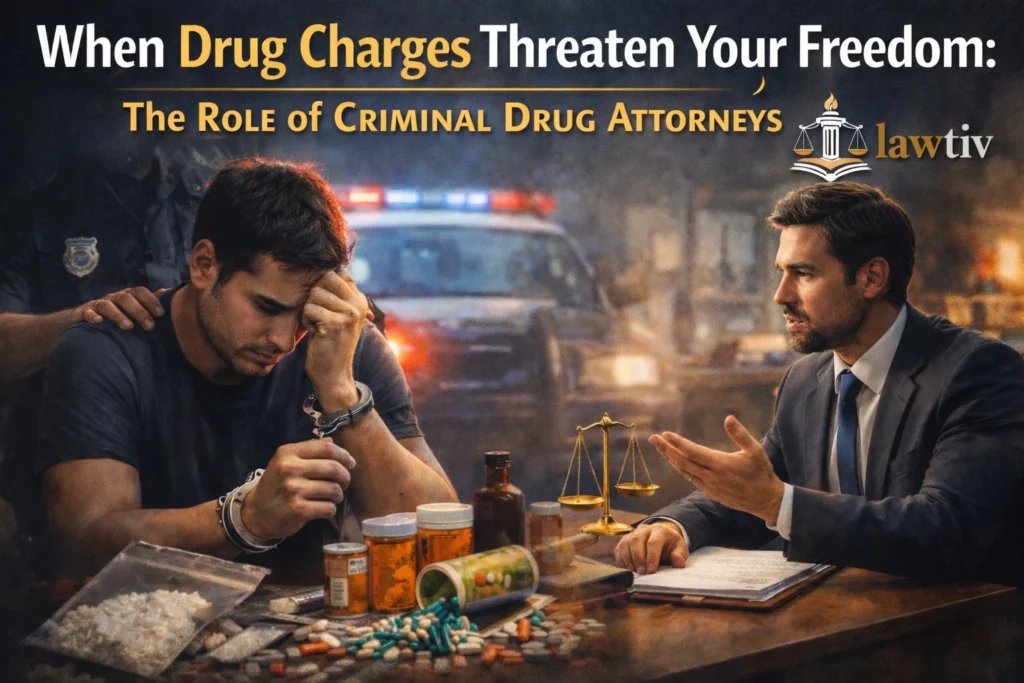
A sudden arrest tied to narcotics can transform a normal day into a legal emergency. Police reports, search warrants, and lab results begin shaping a case long before the accused fully understands the allegations. Charges involving controlled substances carry the weight of prison exposure, financial penalties, and a criminal record that may follow someone for decades.
Prosecutors across the United States treat drug crimes as high priority offenses. Federal agencies, state police, and local narcotics units invest enormous resources into investigations that target possession, manufacturing, and trafficking. That intensity means defendants enter a legal battlefield where mistakes carry severe consequences.
Criminal drug attorneys operate within this pressure filled environment. Their work involves far more than courtroom arguments. Defense begins with examining the legality of arrests, the credibility of confidential informants, and the scientific reliability of drug testing. The attorney’s strategy often determines whether a case collapses early or proceeds toward trial.
A seasoned drug defense lawyer studies the intersection of criminal law, constitutional protections, and forensic science. Each decision shapes the outcome. In many cases, a well executed defense changes the trajectory of a person’s life.
The Legal Landscape of Drug Crimes in the United States
Drug law in the United States operates through overlapping state statutes and federal legislation. This layered system creates a complex environment where identical conduct can trigger different legal consequences depending on jurisdiction.
At the federal level, the Controlled Substances Act organizes narcotics into schedules based on medical use and potential for abuse. Substances such as heroin and LSD fall under Schedule I, meaning they carry the highest restrictions. Prescription medications like oxycodone appear in lower schedules yet still trigger serious criminal liability when possessed unlawfully.
States adopt their own criminal codes. While many laws mirror federal scheduling, penalties differ widely. A possession case that might qualify for diversion in one state could lead to incarceration in another. Criminal drug attorneys evaluate these variations carefully while building defense strategies tailored to the jurisdiction.
Drug enforcement also involves a broad network of agencies. The Drug Enforcement Administration leads federal investigations involving trafficking and interstate distribution. Local police departments run specialized narcotics units focused on street level activity. Each agency follows investigative procedures that defense lawyers scrutinize for constitutional violations.
Federal Drug Offenses and Mandatory Sentencing
Federal drug prosecutions often emerge from investigations involving large scale distribution networks. These cases involve wiretaps, confidential informants, and undercover operations coordinated across multiple states.
The federal system includes mandatory minimum sentencing laws. These statutes impose fixed prison terms tied to drug quantity and prior convictions. For example, trafficking cases involving certain quantities of cocaine or methamphetamine can trigger minimum sentences measured in decades.
Criminal drug attorneys defending federal cases must navigate complex sentencing guidelines. The United States Sentencing Commission framework evaluates factors such as role in the offense, prior criminal history, and drug weight calculations. Each factor influences potential prison exposure.
Defense strategy often begins with challenging the quantity attributed to a defendant. Prosecutors sometimes rely on testimony from cooperating witnesses who estimate drug amounts. Experienced attorneys attack these estimates through cross examination and forensic evidence.
State Drug Charges and Local Prosecution
Most drug arrests in the United States occur under state law rather than federal statutes. These cases range from simple possession to large scale trafficking conspiracies.
State courts handle a wide variety of narcotics allegations. Possession of marijuana may involve minimal penalties in some jurisdictions while remaining criminal in others. Charges involving heroin, fentanyl, cocaine, or methamphetamine frequently carry harsher consequences.
Local prosecutors evaluate drug cases based on factors such as quantity, location, and criminal history. Distribution allegations often emerge when police discover packaging materials, digital scales, or large amounts of cash during a search.
Criminal drug attorneys working in state courts often challenge the foundation of the case itself. Was the traffic stop lawful? Did officers obtain a valid search warrant? Was probable cause present during an arrest? Answers to these questions shape the direction of the defense.
What Criminal Drug Attorneys Actually Do for Clients
A criminal drug attorney’s responsibilities extend far beyond courtroom appearances. Defense begins the moment a client faces investigation or arrest.
Lawyers analyze police reports, witness statements, and forensic evidence with meticulous attention. Drug prosecutions frequently rely on confidential informants, undercover operations, and surveillance techniques. Each investigative method presents opportunities for legal challenges.
Defense attorneys also serve as navigators through the procedural complexities of criminal court. Arraignments, pretrial motions, evidentiary hearings, and plea negotiations each require strategic decision making.
Clients often encounter overwhelming uncertainty during these stages. A defense lawyer translates legal language into practical understanding while safeguarding constitutional protections.
Case Investigation and Evidence Analysis
A strong defense rarely begins in the courtroom. The investigative phase determines whether prosecutors possess reliable evidence capable of surviving legal scrutiny.
Criminal drug attorneys review how law enforcement obtained evidence. Search warrants must comply with strict constitutional standards under the Fourth Amendment. If officers conducted an illegal search or seizure, courts may exclude the resulting evidence.
Drug cases often hinge on laboratory analysis confirming the identity of substances. Defense lawyers evaluate whether forensic testing followed accepted scientific protocols. Errors in lab handling or chain of custody can undermine the prosecution’s case.
Attorneys may also employ independent investigators. Witness interviews, surveillance reviews, and location analysis sometimes reveal inconsistencies in the government’s narrative.
Protecting Constitutional Rights During Investigations
Drug investigations frequently involve aggressive policing methods. Undercover purchases, confidential informants, and electronic surveillance form the backbone of many cases.
These tactics operate within constitutional boundaries that defense attorneys monitor closely. Illegal wiretaps, improper informant payments, or coerced statements can violate due process protections.
Criminal drug attorneys challenge these violations through pretrial motions. Courts may suppress evidence obtained through unconstitutional methods, significantly weakening the prosecution’s position.
Protection of rights extends beyond technical legal arguments. Defense lawyers ensure that clients avoid self incriminating statements during police questioning. Early legal representation often prevents investigators from building cases based on unguarded remarks.
Common Drug Charges Handled by Defense Lawyers
Drug prosecutions vary widely in severity. Some involve personal possession while others focus on complex trafficking networks spanning multiple states.
Criminal drug attorneys encounter a spectrum of allegations tied to controlled substances. Each charge carries unique legal elements that prosecutors must prove beyond reasonable doubt.
Defense strategy depends heavily on the nature of the accusation. Evidence required to prove possession differs significantly from evidence needed to establish trafficking or manufacturing.
Drug Possession Charges
Possession remains the most common drug offense in American courts. Police typically file these charges after discovering narcotics during traffic stops, home searches, or street encounters.
Prosecutors must prove that the accused knowingly possessed a controlled substance. Possession may be actual, meaning drugs were found directly on the person, or constructive, meaning the individual had control over the location where drugs were discovered.
Criminal drug attorneys frequently challenge constructive possession cases. Shared apartments, vehicles with multiple occupants, or public spaces create ambiguity regarding ownership of narcotics.
Defense lawyers also evaluate laboratory testing procedures. Prosecutors must confirm the chemical identity of substances through certified forensic analysis. Errors in testing can dismantle possession cases.
Drug Distribution and Trafficking Allegations
Distribution and trafficking charges carry far more severe consequences than simple possession. These allegations often involve claims that a defendant sold, transported, or intended to sell controlled substances.
Police look for indicators of distribution such as large quantities of drugs, packaging materials, digital scales, and cash. Text messages or phone records sometimes appear in evidence to suggest drug sales.
Criminal drug attorneys attack these indicators carefully. Possession of large amounts alone does not automatically prove intent to distribute. Defense lawyers often argue that the evidence lacks proof of actual transactions.
Trafficking cases may also involve conspiracy charges. Prosecutors attempt to link multiple individuals through alleged agreements to distribute drugs. Defense attorneys examine whether genuine evidence supports the claim of a coordinated operation.
Prescription Drug and Opioid Cases
The opioid crisis brought intense scrutiny toward prescription medications. Drugs such as oxycodone, hydrocodone, and fentanyl frequently appear in criminal prosecutions.
Possession without a valid prescription can trigger criminal charges. Distribution cases sometimes involve allegations of prescription fraud or illegal diversion from medical supply chains.
Criminal drug attorneys defending these cases often explore medical documentation and prescription histories. A legitimate prescription can serve as a powerful defense when authorities misunderstand the circumstances.
Opioid prosecutions also raise questions about addiction and treatment. Some jurisdictions offer diversion programs emphasizing rehabilitation rather than incarceration.
Defense Strategies Used by Criminal Drug Attorneys
Defense in drug cases involves a combination of legal analysis, investigative work, and courtroom advocacy. No single strategy fits every situation.
Experienced attorneys develop case specific approaches after reviewing evidence and legal procedures. Many defenses focus on weaknesses within the prosecution’s investigative methods.
Challenging Search and Seizure Procedures
Search and seizure law forms the backbone of many drug defenses. The Fourth Amendment protects citizens against unreasonable government intrusion.
Police often rely on warrants to search homes, vehicles, and digital devices. Defense attorneys examine whether the warrant application established probable cause supported by credible evidence.
Warrantless searches sometimes occur during traffic stops or emergency situations. Courts evaluate whether officers possessed lawful justification for these actions.
If a search violated constitutional standards, judges may suppress the resulting evidence. Without the drugs themselves, prosecutors often struggle to continue the case.
Questioning Informants and Witness Credibility
Confidential informants play a major role in narcotics investigations. Many informants cooperate with law enforcement in exchange for reduced charges or financial incentives.
Criminal drug attorneys scrutinize these arrangements carefully. Informants facing their own legal troubles may exaggerate or fabricate allegations to gain favorable treatment.
Cross examination becomes a critical tool during trial. Defense lawyers highlight inconsistencies, past criminal history, and motivations for cooperation.
Witness credibility often determines whether a jury accepts the prosecution’s narrative. Skillful questioning can shift the entire direction of a case.
Attacking Forensic Evidence
Drug prosecutions frequently rely on laboratory testing to identify controlled substances. These tests must follow strict protocols to produce reliable results.
Defense attorneys evaluate chain of custody documentation showing how evidence moved from police collection to laboratory analysis. Breaks in the chain create opportunities for contamination or misidentification.
Forensic chemists sometimes testify regarding testing procedures. Defense lawyers may challenge the methodology or qualifications of these experts during trial.
Scientific scrutiny can expose weaknesses within laboratory operations. In some cases, flawed testing procedures have led courts to dismiss charges entirely.
The Court Process in U.S. Drug Crime Cases
Drug prosecutions follow a structured path through the criminal justice system. Each stage presents opportunities for legal maneuvering and negotiation.
Criminal drug attorneys guide clients through these proceedings while protecting their rights at every step.
Arrest, Arraignment, and Bail
Drug cases often begin with an arrest based on probable cause. Police may take suspects into custody immediately or issue a summons requiring court appearance.
During arraignment, the court formally presents charges. Defendants enter an initial plea and receive information about bail conditions.
Judges consider factors such as criminal history and flight risk when determining bail. Criminal drug attorneys advocate for reasonable conditions allowing clients to remain free while preparing their defense.
Pretrial Motions and Plea Negotiations
Pretrial litigation forms a crucial stage in drug cases. Defense attorneys file motions challenging evidence, search procedures, or witness credibility.
Courts hold hearings to determine whether the prosecution’s evidence remains admissible. Successful motions can dramatically weaken the government’s case.
Plea negotiations often occur alongside these legal battles. Prosecutors sometimes offer reduced charges in exchange for guilty pleas. Defense lawyers evaluate whether these offers align with the strength of the evidence.
Strategic negotiation requires careful judgment. Accepting a plea may protect a client from severe sentencing exposure, while rejecting an offer might lead toward trial.
Trial and Sentencing
If negotiations fail, the case proceeds to trial. Prosecutors must convince a jury beyond reasonable doubt that the defendant committed the alleged offense.
Criminal drug attorneys present alternative interpretations of the evidence. Cross examination, expert testimony, and constitutional arguments form the foundation of the defense.
If a conviction occurs, sentencing follows. Judges evaluate statutory guidelines, criminal history, and aggravating or mitigating factors.
Defense lawyers continue advocating during this stage, presenting arguments supporting reduced penalties or alternative sentencing programs.
How to Select the Right Criminal Drug Attorney in the United States
Choosing legal representation during a drug prosecution may shape the entire outcome of a case. Not every criminal lawyer possesses the same depth of experience in narcotics defense.
A qualified attorney demonstrates familiarity with both federal and state drug laws. Experience handling complex investigations involving informants, surveillance, and forensic testing becomes crucial.
Courtroom experience also matters. Some drug cases proceed to jury trial where persuasive advocacy can determine a verdict. Lawyers who regularly litigate these matters bring valuable insight into courtroom dynamics.
Reputation within the legal community often signals competence. Judges, prosecutors, and fellow defense attorneys develop strong impressions of lawyers who consistently handle complex cases.
Communication remains another key element. A defense attorney should explain legal developments clearly while maintaining transparency regarding possible outcomes. Clients facing drug charges require guidance grounded in honesty and practical judgment.
Practical Outcomes and Long Term Consequences of Drug Convictions
Drug convictions extend far beyond courtroom penalties. Criminal records can affect employment opportunities, housing eligibility, and professional licensing.
Federal law imposes additional restrictions related to firearms possession and immigration consequences. Non citizens convicted of drug offenses may face deportation proceedings regardless of sentence length.
Criminal drug attorneys evaluate these broader implications while advising clients on legal strategy. In some cases, avoiding a conviction entirely becomes the most critical objective.
Diversion programs, drug treatment courts, and probationary sentences sometimes offer alternatives to incarceration. These options often require negotiation with prosecutors and approval from the court.
Long term consequences illustrate why early legal intervention carries enormous value. Decisions made during the early stages of a drug case often determine whether a person faces years of lasting impact.
Frequently Asked Questions About Criminal Drug Attorneys
What does a criminal drug attorney do during a drug arrest case?
A criminal drug attorney investigates how law enforcement obtained evidence, evaluates laboratory testing, and challenges procedural violations. The lawyer also represents the client during court hearings and negotiations with prosecutors. Defense strategies often focus on constitutional protections related to search and seizure or unreliable witness testimony.
How serious are federal drug charges in the United States?
Federal drug prosecutions carry severe penalties because many offenses involve mandatory sentencing laws. Cases often arise from large investigations involving trafficking networks. Defense attorneys analyze drug quantity calculations, informant testimony, and surveillance procedures while building a defense.
Can drug charges be dismissed before trial?
Dismissals occur when defense attorneys demonstrate legal weaknesses in the prosecution’s case. Illegal searches, flawed warrants, unreliable forensic testing, or constitutional violations can lead courts to exclude evidence. Without sufficient proof, prosecutors may abandon the case.
What happens if someone is caught with prescription medication without a prescription?
Possession of prescription drugs without valid authorization may lead to criminal charges depending on the substance and jurisdiction. Criminal drug attorneys examine medical records and prescription histories to determine whether a legitimate explanation exists.
Do all drug cases go to trial?
Most drug cases resolve through negotiations rather than jury trials. Defense attorneys evaluate plea offers alongside the strength of the prosecution’s evidence. Some cases proceed to trial when legal issues or factual disputes require a jury decision.
How early should someone contact a criminal drug attorney?
Legal representation should begin as soon as a person suspects investigation or faces arrest. Early involvement allows attorneys to protect constitutional rights and guide interactions with law enforcement.
Closing Perspective on Drug Defense Representation
Drug prosecutions represent one of the most complex areas of criminal law in the United States. Investigations blend constitutional law, forensic science, and aggressive policing tactics. Individuals facing these allegations confront legal systems designed to impose severe consequences.
Criminal drug attorneys operate at the center of this environment. Their work requires precision, persistence, and a deep grasp of legal strategy. Each case presents unique circumstances that demand tailored defense approaches.
For defendants, the presence of a knowledgeable defense lawyer often becomes the difference between overwhelming prosecution and a carefully contested case. Strong legal advocacy preserves rights, exposes investigative flaws, and protects the principle that guilt must be proven beyond reasonable doubt.
